

A Brief History of Tea
First of all, it is necessary to clarify that the term "tea" refers to an evergreen plant belonging to the Camellia genus. Specifically, out of about 80 types of Camellias, 2 are used to obtain our beloved beverage:
- the Camellia Sinensis var. Sinensis, native to Yunnan (China), has plants up to 3 meters tall with small leaves
- the Camellia Sinensis var. Assamica, native to Assam (India), can reach over 10 meters in height, grows more rapidly, and has longer leaves
The populations of these places have used its leaves since ancient times, albeit in ways often very different from what we are accustomed to in the West today.
Used as far back as 3,000 years ago in Chinese medicine, it only spread around the 3rd century thanks to Buddhist monks and became an "official" beverage during the Tang Dynasty (618-907 AD). During the Song Dynasty (960-1279 AD), the Chinese art of tea was further perfected and arrived in Japan, where the tea ceremony (Cha no yu) was codified in the 16th century.
Europe would have to wait until 1610, the year the Dutch East India Company introduced tea first to Holland, then to France, and finally to England and the rest of the Continent.
In the 19th century, tea became the national drink of England, so much so that it induced the crown to establish the first plantations in India in 1834, followed by those in Ceylon (present-day Sri Lanka) and the British colonies in East Africa.
Main Types of Tea
The various types of tea are obtained starting from the leaves of the same plant, but depending on the type of processing and oxidation, they are divided into 5 fundamental types:
WHITE TEA
-
Color in the cup: Pale yellow, very light.
-
The Essence: It is the least processed tea of all. Often, only the buds or the youngest leaves covered in silvery down are used.
-
The Process:
-
Delicate harvesting.
-
Natural withering (in the sun or air).
-
Slow drying.
-
-
Oxidation Level: Almost zero (0-5% natural).
-
Flavor Profile: Delicate, subtle, floral, sweet, notes of fresh hay or light honey.
GREEN TEA
-
Color in the cup: From vibrant yellow-green to light green.
-
The Essence: The goal is to preserve the green color and freshness by immediately stopping oxidation with heat.
-
The Process:
-
Harvesting.
-
Fixation: Immediate heating via steam (Japanese method) or hot pans (Chinese method) to stop enzymes.
-
Rolling (to give shape).
-
Drying.
-
-
Oxidation Level: Stopped (0%).
-
Flavor Profile: Herbaceous, vegetal (seaweed, spinach), fresh, sometimes toasted or with "umami" notes.
OOLONG TEA
-
Color in the cup: Varies enormously, from golden yellow to dark amber.
-
The Essence: It is the most varied category. Tea masters meticulously control the oxidation to create complex layers of aroma.
-
The Process:
-
Withering under the sun.
-
Shaking: The leaves are shaken in bamboo baskets to bruise the edges and begin oxidation.
-
Controlled partial oxidation.
-
Firing to stop oxidation.
-
-
Oxidation Level: Semi-oxidized (varies from 10% to 80%).
-
Flavor Profile: Incredibly varied. Floral (orchid, gardenia), fruity (peach), creamy, or toasted and woody.
BLACK TEA
-
Color in the cup: Intense ruby red, dark brown.
-
The Essence: The leaves are fully oxidized to develop strong, decisive flavors and a dark color.
-
The Process:
-
Withering.
-
Intense Rolling: The leaves are broken or rolled to expose essential oils to the air.
-
Full Oxidation: The leaves rest in humid environments until they turn dark.
-
Drying (firing).
-
-
Oxidation Level: Complete (100%).
-
Flavor Profile: Bold, malty, earthy, notes of cocoa, dried fruit, or spices.
PU-ERH TEA
-
Color in the cup: Very dark red, brown, sometimes almost black and opaque.
-
The Essence: A "living" and unique tea. It is not just oxidized; it is microbially fermented and often aged for years.
-
The Process (Simplified for the "Shou/Ripe" type):
-
Starting from a base similar to green tea (Maocha).
-
Pile fermentation: The leaves are stacked, dampened, and covered to promote microbial activity (controlled composting).
-
Often compressed into shapes (cakes, bricks, nests).
-
Aging.
-
Oxidation/Fermentation Level: Continuous microbial post-fermentation.
-
Flavor Profile: Earthy, notes of forest floor, mushrooms, leather. Very smooth, without bitterness, deep taste that evolves over time.
Tea by the Numbers
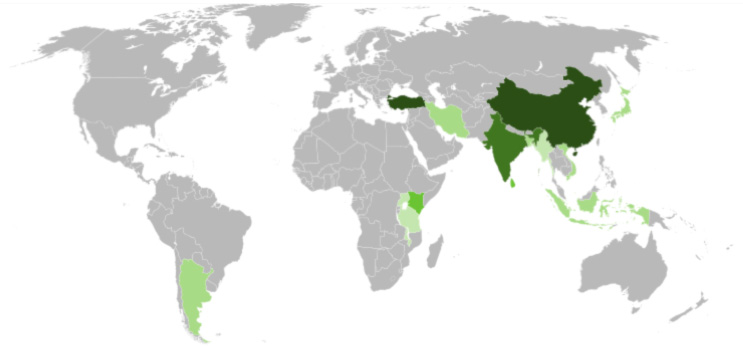
WORLD TEA PRODUCTION (Main Producing Countries)
This table lists the major tea-producing countries in the world, with estimates of their annual production.
| Country | Estimated Annual Production (Millions of Kg) | Global Market Share (%) | Main Types of Tea Produced | Notes |
| China | 2,900 - 3,200 | 40-45% | Green, Black, Oolong, White, Pu-Erh, Yellow | The largest producer and consumer, home to all types of tea. |
| India | 1,200 - 1,400 | 18-20% | Black (Assam, Darjeeling, Nilgiri) | Famous for strong and robust black tea. Large domestic consumption. |
| Kenya | 450 - 550 | 6-8% | Black (CTC) | World's leading exporter of black tea. Production primarily for export. |
| Sri Lanka | 300 - 350 | 4-5% | Black (Ceylon), Green, White | Famous for "Ceylon" (black) tea, produced at various altitudes. |
| Turkey | 250 - 280 | 3-4% | Black | Production almost exclusively for domestic consumption. |
| Vietnam | 220 - 250 | 3% | Black, Green, Oolong | Production is growing, for both domestic consumption and export. |
| Indonesia | 130 - 150 | 2% | Black, Green | Significant production, with a relevant portion destined for export. |
| Japan | 80 - 90 | 1% | Green (Sencha, Matcha, Gyokuro) | Focused on high-quality and traditional green teas. High domestic consumption. |
| Argentina | 70 - 80 | 1% | Black | Mainly for the production of tea bags and iced tea. |
| Others | (Various) | (Various) | (Various) | Includes countries like Bangladesh, Nepal, Uganda, Tanzania, Iran. |
| TOTAL | Approx. 6,000 - 7,000 Million Kg | 100% |
WORLD TEA CONSUMPTION (Main Consuming Countries Per Capita and Total)
This table explores tea consumption, both in terms of per capita consumption (how much tea an average person drinks) and total consumption (the overall volume consumed by the country).
| Country | Estimated Annual Per Capita Consumption (kg per person) | Estimated Annual Total Consumption (Millions of kg) | Preferred Tea Types | Notes |
| Turkey | 3.0 - 4.0 | Approx. 250-280 | Black | The highest per capita consumption in the world. An integral part of the culture. |
| Ireland | 2.0 - 2.5 | Approx. 10-12 | Black | Strong tea tradition, often with milk and sugar. |
| United Kingdom | 1.5 - 2.0 | Approx. 100-130 | Black | Tea is a national drink. |
| Iran | 1.0 - 1.5 | Approx. 80-100 | Black | High consumption and part of social culture. |
| Russia | 0.8 - 1.2 | Approx. 140-170 | Black | Large total consumer, tea is essential in cold regions. |
| China | 0.6 - 1.0 | Approx. 1,000 - 1,400 | Green, Oolong, Pu-Erh, White | The largest total consumer, with a vast range of teas. |
| India | 0.7 - 0.9 | Approx. 950 - 1,200 | Black (Masala Chai) | High total consumption, especially of black tea prepared with spices and milk. |
| Japan | 0.8 - 1.0 | Approx. 80-90 | Green (Sencha, Matcha) | Strong green tea culture, both daily and ceremonial. |
| Egypt | 0.7 - 0.9 | Approx. 60-70 | Green (often with mint and lots of sugar) | Tea is a very popular social drink. |
| Morocco | 0.6 - 0.8 | Approx. 20-30 | Green (often with mint and lots of sugar) | Strong mint tea tradition. |
| Pakistan | 0.5 - 0.7 | Approx. 120-150 | Black | Tea is a popular and widely consumed drink. |
| GLOBAL TOTAL | Approx. 0.7 - 0.9 kg per person | Approx. 6,000 - 7,000 Million kg |
More than 3 billion cups of tea are consumed every day!
What about Italy?
It is difficult to provide an exact number of "cups" because the figure varies enormously between those who never drink it and enthusiasts, but we can deduce a realistic estimate by comparing the data:
-
Coffee vs. Tea: If ~95 million coffees are drunk in Italy every day, the estimate for tea and herbal teas (prepared at home/in bars) is likely between 15 and 20 million cups per day.
-
Frequency: About 40% of Italians declare that they habitually consume herbal teas or infusions.
-
Per capita: While coffee consumption is about 5-6 kg per head per year, that of tea and herbal teas (dry raw material) is estimated at between 0.2 and 0.3 kg per head, but with a very high yield per cup (a few grams make a cup).
The way Italians drink tea is changing radically:
-
The Rise of Herbal Teas: Unlike in other countries, in Italy herbal teas and infusions often exceed the consumption of traditional tea. Chamomile remains "the queen" of infusions, but ginger, lemon, and detox blends are growing.
-
Generation Z and Iced Tea: The 18-24 age group is driving the growth. For them, tea is not just a hot drink, but also artisanal iced teas (not just industrial bottled ones) and Matcha.
-
Premiumization: There is a shift from "commodity" products (the classic cheap supermarket tea bag) towards Premium, Organic, and Whole Leaf products. The consumer is willing to pay more for quality and sustainable packaging.
-
Consumption times: Tea/herbal tea is conquering the after-dinner (relaxation time) and the afternoon (work break), slightly eroding the space of the afternoon coffee.
Consumption Growth:
-
In Italy, there is double-digit growth for the functional herbal tea and infusion sector (up to +24% in some recent periods), a sign that Italians are looking for drinks with specific benefits (digestive, relaxing, draining).
-
Tea sales have grown by about +14% in the last year, a performance significantly higher than the food industry average.
Tea Chemistry
There are many chemical substances contained in a tea leaf; the main ones are as follows:
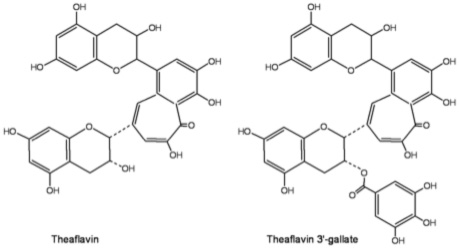
Amino Acids
Tea contains about 2 dozen amino acids, the most important of which is certainly theanine, responsible for transmitting the flavor of the tea. Theanine also helps to reduce the stimulating effect caused by caffeine.
Tannins (Catechins)
Tea contains a massive amount of catechins with antioxidant effects (they counteract the effect of free radicals). In black teas, processing modifies the composition of catechins, transforming them into theaflavins and thearubigins, responsible for aroma and color respectively. The teas with the highest catechin content are green, white, and low-oxidation oolong teas.
Alkaloids (Methylxanthines)
The content of methylxanthines (caffeine, theobromine, and theophylline) varies based on the type of tea, the temperature of the water used, and the infusion time. Black tea generally contains more caffeine, while the other two xanthines are contained in higher percentages in green tea. The caffeine content varies from 1 to 5% of the leaf weight (from 20mg to 50mg of caffeine in a 150ml cup). An adult can consume up to 400 mg of caffeine per day without incurring cardiovascular problems and mood alterations. Alkaloids have certainly contributed to its spread in human habits since ancient times.
Vitamins and Minerals
Tea leaves contain beta-carotene (converted by the liver into Vitamin A), Vitamin E, Vitamin B1, B2, B6, and Vitamin C. Also present are: Potassium, Fluorine, Zinc, Iron, Calcium, Magnesium, and Manganese.
Benefits of Tea
Since ancient times in China, tea has been considered a plant with therapeutic capabilities, and it is undeniable that its healthy properties have contributed to its spread throughout the world. Let's look in detail at the benefits of the main chemical components contained in tea: Caffeine acts as a stimulant on human mental faculties, reducing the feeling of fatigue. It also increases renal circulation, thereby stimulating diuresis.
Catechins have properties:
- antioxidant.
- lowering bad cholesterol levels and triglycerides, thus reducing the risk of cardiovascular diseases.
- decreasing glucose at the intestinal level.
- lowering blood pressure.
- calming activity on the mucous membranes of the stomach and intestine.
The vitamins and minerals present in tea:
- Vitamin B1 stimulates carbohydrate metabolism to provide energy to the brain.
- Vitamin B2 serves to facilitate fat and carbohydrate metabolism.
- Vitamin B6 for the maintenance of skin and hair.
- Vitamin C which strengthens the immune system.
- Zinc strengthens the immune system.
- Calcium and Magnesium are essential components of bones and teeth.
- Manganese activates enzymes responsible for blood clotting and sugar and fat metabolism.
- Finally, Fluorine prevents tooth decay in addition to being an important component of bones and nails.
Preparation of loose leaf tea
This table summarizes the ideal parameters for Western-style infusion (in a cup or classic teapot).
| Tea Color | Type | 🌡️ Water Temperature | ⏱️ Infusion Time | 📝 Key Notes |
| ⚪ White | Bai Mu Dan, Silver Needle | 80°C - 85°C | 3 - 5 minutes | Very delicate. Do not use boiling water. |
| 🟢 Green (Chinese) | Longjing, Gunpowder | 75°C - 80°C | 2 - 3 minutes | Becomes bitter if the water is too hot. |
| 🟢 Green (Japanese) | Sencha, Gyokuro | 60°C - 70°C | 1 - 2 minutes | Requires lower temperatures to enhance umami. |
| 🔵 Oolong | Tieguanyin, Oriental Beauty | 85°C - 90°C | 3 - 4 minutes | Leaves expand significantly; leave room in the teapot. |
| 🔴 Black | Earl Grey, Darjeeling, Assam | 100°C | 3 - 5 minutes | Can withstand high temperatures. |
| 🟤 Pu-erh | Fermented / Dark Tea | 100°C | 3 - 5 minutes | Rinse the leaves with boiling water for 10s before brewing. |
| 🌿 Herbal Tea | Chamomile, Hibiscus, Rooibos | 100°C | 5 - 7 minutes | Requires heat and time to extract essential oils. |
To make a good tea, it is important that the leaves are of high quality and that the preparation follows a few simple rules, which vary depending on the type of tea.
The amount of leaves needed for a standard cup is about 2 grams (one teaspoon).